Before You Start Kid-Safe Crafts: Run This 8-Step Checklist
Read the whole label, not the 'kid-safe' tag: anything marked POISON or DANGER stays out of the kids' bin, and WARNING or CAUTION signals a significant hazard. Then check the ACMI seal, the original container and the project card with the 8-step checklist below.
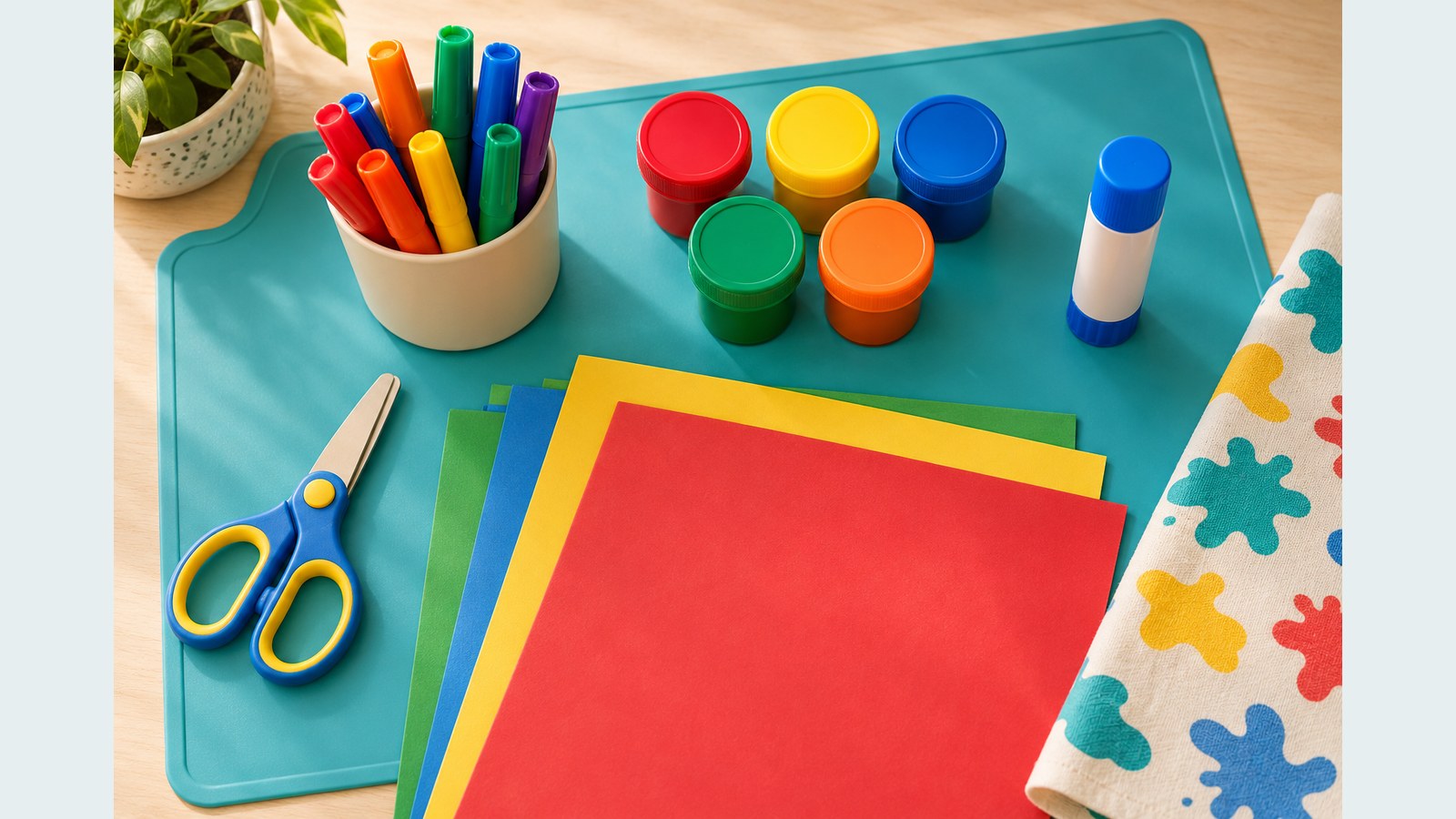
A “non-toxic” tag on a craft supply doesn’t make it safe. Safegard’s craft safety guide says it flatly: “Non-toxic labels should not be taken to mean that the material is completely safe.” The useful lines are the signal word, the seal and the original container.
Before any kid-safe craft starts, run the 8 steps. In one line: original container, signal word, hazard phrase, seal, supply type, project card, amount, then supervision and a soap-and-water handwash.
Red flag: A supply marked POISON or DANGER stays out of the kids’ bin, even when the front of the package says “non-toxic.”
Kid-Safe Crafts Start With the Full Label, Not the Tag
Even the full label can be incomplete. Safegard warns: “Product labels may not list all the ingredients.”
So a label works as a filter, not a guarantee. It can flag a hazard, show a seal and tell you how to use the product. It can’t promise that every ingredient is listed.
HealthyChildren.org is the parent site of the American Academy of Pediatrics (AAP). Its art-supply guide carries the byline of Sophie J. Balk, MD, and Ruth A. Etzel, MD, PhD.
The guide’s answer on crayons says the label should state that the product complies with D4236, a label created by the American Society for Testing and Materials (ASTM). The crayon label should also carry the seal of the Art and Creative Materials Institute (ACMI).
The same page adds three checks by product type. Crayon ingredients should not include talc. Paints should be formaldehyde-free, and water-based, unscented markers beat permanent ones.
Four Signal Words Tell You What Hazard a Supply Carries
A signal word is the single capitalized word that says how serious a hazard is. Safegard’s guide explains each one:
- POISON: hazardous art and craft products must display this sign.
- DANGER: the product is very toxic, highly flammable, or burns the skin or eyes on contact.
- WARNING or CAUTION: the word “signals significant hazard,” and the phrase after it names the hazard, such as “Harmful if swallowed,” “Avoid skin contact” or “Flammable.”
Read the phrase after WARNING or CAUTION before you decide. “Avoid skin contact,” for example, rules that product out for finger painting.
A marker labeled “permanent” is likely aromatic solvent-based, meaning its ink uses a chemical solvent instead of water, per Safegard. Safegard calls that type the most hazardous of 3 marker kinds. HealthyChildren.org points children to water-based, unscented markers instead.
A “use with adequate ventilation” line is a setup instruction. Safegard’s fix: use a fan, work outdoors, or skip the product. With a fan, open a window, set the fan on the far side of the work area, and point it toward the window.
An 8-Step Pre-Craft Checklist Covers the Supply and the Project
The label guides stop at the product, and project listings stop at the craft. This list joins them, so you check the supply and the setup in one pass.
- Container. Use a supply only if it is in its original, fully labeled container. HealthyChildren.org advises against donated or found materials that aren’t.
- Signal word. Read every side for POISON or DANGER, and keep either one out of the kids’ bin.
- WARNING or CAUTION. Read the hazard phrase and the directions, including any “use with adequate ventilation” line.
- Seal and standard. For crayons, look for the ACMI seal, an ASTM D4236 statement and no talc in the ingredients, as HealthyChildren.org’s crayon answer advises.
- Type. Pick water-based, unscented markers and formaldehyde-free paints. Treat “permanent” as a solvent clue.
- Project card. Confirm the age, supplies, mess level and time. PureWow’s toddler craft list uses that format: age range, supplies, messiness level, time range.
- Amount. Buy and set out only the amount the project needs, as Safegard advises.
- Supervision and cleanup. Stay with your child while they work, and end with handwashing with soap and water, per HealthyChildren.org. Put leftovers back in their original labeled containers.
See also: craft storage carts on wheels: drawers, brakes and price per drawer.
PureWow’s Snack-Time Farm Craft Is Listed for Ages 2+
This project leans on steps 6 to 8. With produce and two tools instead of paint or glue, the project card, the amount and your supervision do most of the work.
Activity card (per PureWow unless marked)
- Age: 2+
- Materials: a kid-safe knife, cookie cutters, fresh produce
- Time: under 1 hour
- Mess level: 2 on PureWow’s 1-to-3 scale
- Skill it builds: cutting and pressing shapes (suggested)
A 2 is the middle of that scale, so plan on juice on the table.
If it goes wrong: If juice runs everywhere, move the cutting onto a tray and finish with the soap-and-water handwash from step 8.
See also: craft safety for kids: why every craft knife stays in adult hands.
Highlights’ Pompom Ice Pops Practice Fine Motor Skills With 3 Supplies
Highlights describes Pompom Ice Pops as pretend ice pops made from colorful pompoms, craft sticks and glue. It says kids practice fine motor skills while making them. Run steps 1 to 5 on each packaged supply, the glue included.
Activity card (per Highlights unless marked)
- Age: 3+, the age Highlights lists for its collection
- Materials: colorful pompoms, craft sticks (1 per pop, suggested), glue
- Time: 30 minutes (suggested)
- Mess level: low (suggested)
- Skill it builds: fine motor skills
Small pompoms need watching. PureWow’s toddler list flags small craft pieces as a choking hazard, so keep the pompom bowl on your side of the table.
If it goes wrong: If the glue bottle has lost its label, swap in a labeled one. Step 1 applies to glue too.
The ACMI Seal Is on the Label; Crayon Asbestos Traces to Talc
Each check has its own place to look:
- Seal: printed on the product. For crayons, HealthyChildren.org names the ACMI seal as the one to find.
- Asbestos: checked through the ingredient list. HealthyChildren.org reports that an Environmental Working Group report found asbestos fibers in 4 crayon brands, and the source was talc used as a binding agent. It rates the risk from typical use as low and gives one fix: make sure the label shows no talc, as step 4 does.
The Rule: Judge a Supply by What It Discloses
- Verdict: The full label is your filter for paints, glues, markers and crayons. You want no red-flag signal word, a WARNING or CAUTION phrase you have read, an original container and, on crayons, the ACMI seal.
- The real limit, and its fix: A label can leave ingredients out, as the first section shows. The fix is the steps that don’t depend on the label: water-based, unscented supplies, a talc check on crayons, and you at the table until the handwash.
- Strengths: The check is free, needs no gear and takes one pass per packaged supply. It catches the warning that hazardous products must display.
- Who should skip a supply: Skip a “permanent” marker and pick a water-based, unscented one. Skip found paint with no original label and pick labeled, formaldehyde-free paint.
Next step: Look up a specific product in the safety and materials guides.
FAQ
Does a “non-toxic” label mean a supply can’t harm my child?
No. Safegard says not to read “non-toxic” as completely safe. The signal word and the hazard phrase tell you more.
Can my child use donated crayons?
Only in their original, fully labeled box, per HealthyChildren.org, and only if the ingredients show no talc.
Do food crafts need a label check?
The produce doesn’t. The knife, adult supervision and the soap-and-water handwash still do.
Sources
- https://www.healthychildren.org/English/safety-prevention/at-home/Pages/Choosing-Safe-Arts-and-Craft-Supplies.aspx
- https://sgclassesonline.com/blog/24-safety-the-first-step-in-every-arts-crafts-project
- https://www.purewow.com/family/crafts-for-toddlers
- https://parents.highlights.com/31-arts-and-crafts-kids-to-make-home